

Imagine playing a two-hour set on a hard wooden stool, shifting uncomfortably as your legs go numb. This was the reality for drummers in the early 20th century! No padding, no height adjustments—just raw discomfort.
Over time, as drumming evolved, so did the demand for better seating. From simple wooden stools to ergonomically designed thrones with memory foam, drum thrones have undergone a remarkable transformation over the centuries.
So, how does the modern-day drum throne differ from the ones that existed four or five generations ago? Let’s see!
Drum Thrones in the Early Days
The beginning of drumming involved drummers having to sit on a wooden stool for the entire duration of their performance. This would lead to discomfort and backache, and even hamper the overall performance.
These stools would be fixed, with no cushioning or height adjustments, leading to a lot of inconvenience for the drummers. At the same time, it is also true that the drum kits used to be simpler, with just one drum and one or two cymbals.
As the kit evolved, the need for the stool to evolve emerged too. However, the pace would not match, as drum thrones were never looked at as an important instrument as part of the kit.
Evolution of the Drum Throne
Over time, companies like Ludwig realized the importance of a drum throne and popularised the term by using it in their catalog in 1937. Thereon, it started gaining attention gradually.

Now, companies like Gibraltar, Roc n Soc, 5 Core, and Donner have understood the contribution of a drum throne in the perfect performance of a drummer. Thus. they have taken care of every minute inconvenience that drummers face today. Such include:
- Sturdiness
- Comfort
- Anti-slip grip
- Height Adjustment
Materials Used in Modern Drum Thrones
Drum thrones today are engineered for precision, comfort, and durability. Every aspect, from the seat design to the base structure, has been refined using advanced materials and ergonomic research.
A modern drum throne is no longer just a stool—it is a crucial piece of equipment that directly impacts a drummer’s performance and endurance. Keeping this in mind, manufacturers like Roc n Soc, 5 Core, Tama, etc., have made many customizations to make the experience immersive for drummers.
Advanced Seat Materials for Added Comfort
Manufacturers now use multi-density foam, plush cushions, vinyl, etc., to balance softness and firm support, ensuring comfort without excessive sinking. Memory foam adapts to the drummer’s body shape, reducing pressure points and enhancing weight distribution.
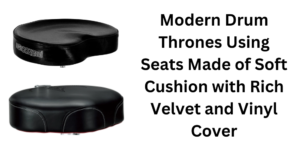
The breathability has also improved considerably over time. Mesh fabric seats allow air circulation, preventing overheating during long performances. This is especially valuable for touring drummers or those playing under high-intensity conditions.
High-strength base Construction for Sturdiness
The materials used in drum throne bases have shifted from traditional steel to rich-quality sponge and velvet. These materials reduce weight while maintaining exceptional durability. Drummers now benefit from lighter yet more stable thrones, making transportation easier without compromising performance.
Most drum thrones today come with a double-braced, three-legged setup. Some even have hydraulic adjustment systems which adds to the convenience of the drummers using them.
Customization and Ergonomics
Modern drum thrones are built with customization in mind. Drummers can now choose from:
- Contoured seats that improve circulation and reduce fatigue.
- Split-seat designs that relieve spinal pressure.
- Hydraulic or spindle height adjustments for precise positioning.
Additionally, anti-slip rubber grips and reinforced locking mechanisms ensure that the throne remains stable, even during high-energy performances.
With these innovations, drum thrones are no longer just an accessory—they are a performance tool. The evolution of materials has turned them into ergonomic, high-tech seating solutions that directly enhance a drummer’s endurance, control, and comfort.
Conclusion
At this point, you must have realized that a drummer’s throne is more than just a seat—it’s where control, comfort, and endurance come together. The right materials can mean the difference between a solid performance and an exhausting struggle.
As drumming evolves, so will the technology behind drum thrones, pushing the limits of what’s possible in stability and support. If you want to explore more about drum stool, you can consider reading our articles:
- Why ergonomic thrones are taking the drumming world by storm?
- Top innovations in drum thrones in 2025
- How to choose a perfect drum throne for your needs?
So, the next time you sit down to play, ask yourself—are you giving your music the foundation it deserves? Maybe it’s time to upgrade.
All Comments
Very informative and educational. Really liked the information
The use of modern materials in drum throne design is a game-changer for comfort and durability. Excited to see how these innovations improve drumming performance.
This was such an interesting read! I never really thought about how much drum thrones have evolved over the years. It’s crazy to imagine drummers playing for hours on just a hard wooden stool—no wonder they had back pain! The advancements in materials and ergonomics make so much sense, especially for those who perform regularly. I love how manufacturers are focusing on comfort and stability now. Makes me wonder… how much of a difference does a high-end drum throne really make in a drummer’s performance? Might be time for an upgrade! 🎶🥁
Got to learn a lot about drum throne from this blog. I love how there are so many customizations available. Modern day drum thrones have so many added features. would love to see more such innovations in future.
Informative and knowledgeable.
Awesome information
Superb
Amazing Blog!!got a lot of knowledge.