
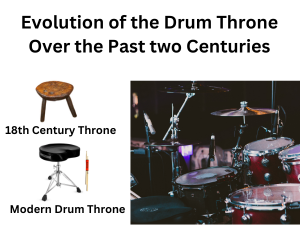
Every drummer knows the feeling: the adrenaline of a live performance, the sweat flowing down your brow, and the relentless rhythm that keeps you going. However, the Drum stool that stays with you for the entire duration, remains underrated.
It’s easy to overlook, but the throne is the foundation of every great performance. It’s where endurance meets posture, where comfort fuels creativity. Yet, the Drum stool wasn’t always the ergonomic masterpiece it is today.
Its journey began with simple wooden stools, barely adjustable and far from comfortable. Over the decades, driven by the demands of drummers who refused to settle, it evolved into a marvel of design and engineering.
So, how exactly did it evolve to become what it is today? Let’s see!
The Evolution of the Drum Stool Over the Years
Ludwig, a Chicago-based drum manufacturer, transformed drumming in 1937 with the first adjustable, foldable Drum stool. Before this, drummers used wooden stools or chairs, offering no support or flexibility.

As jazz and swing drumming evolved, stability and comfort became essential, especially with the rise of bass drum pedals. Ludwig’s design gave drummers better posture, control, and endurance, allowing them to play longer and with greater precision.
| Did You Know?
The National Museum of American History houses a Ludwig drummer’s throne used by jazz drummer Ray McKinley between 1969 and 1980, highlighting the design and build of thrones from that era |
This innovation redefined drumming, pushing other manufacturers like Gretsch and Slingerland to adopt and refine the concept. The term “drummer’s throne” became standard, symbolizing the drummer’s central role in a band.
The Quest for Comfort in Drum Stools (1960s – 1980s)
The Need for Stronger Thrones to Meet Drumming Styles
Rock drumming demanded powerful strokes, rapid footwork, and constant movement. Early thrones, built for jazz, lacked the stability to handle the physical intensity of rock performances.
Drummers like John Bonham and Keith Moon played with force, often causing lightweight thrones to tip or slide. Thus, to meet the changing needs, manufacturers reinforced the base with wider legs and rubber feet, preventing unwanted movement.
Metal construction replaced weaker wooden designs, improving weight distribution and durability. These upgrades allowed drummers to focus on performance without worrying about their seat shifting.
The Shift to Better Cushioning to Mitigate Discomfort
Oftentimes, extended sets left drummers with lower back pain and leg fatigue. The thin, flat cushions of early thrones failed to provide long-term support, making comfort a growing concern.
At this point, Foam padding became a key innovation, reducing strain on the spine and legs. A new design of rounded, contoured seats replaced flat surfaces. This would provide better ergonomic support for longer performances.
Some manufacturers even experimented with memory foam and gel inserts, allowing the seat to mold to the drummer’s posture. This helped reduce discomfort and improve the overall endurance.
Height Adjustments for Versatility of the Drummer
Another matter of concern over time was the fixed height of the age-old stools. Fixed-height stools forced drummers to adjust their playing instead of their seating.
The introduction of spindle-based adjustments allowed drummers to fine-tune their height by rotating the seat. Later, hydraulic mechanisms offered even quicker modifications with a simple lever.
These innovations helped drummers find the perfect ergonomic position, improving foot control over bass pedals. It also helped in reducing unnecessary strain on their legs and lower back.
The Modern Drum Stool – Precision, Comfort, and Endurance (1990s–Present)
The quest for perfection has remained permanent forever. The drum seat is no exception. It has evolved over time with top-notch features to help drummers attain their necessary level of comfort.
Ergonomics Take Center Stage to Add Extra Comfort
As drummers faced long rehearsals and intense tours, ergonomic support became crucial. Traditional round seats were often uncomfortable for extended play.
Drum Stool Manufacturers introduced motorcycle-style and saddle-shaped thrones, designed to support natural posture and reduce lower back strain. These shapes helped distribute weight evenly, preventing fatigue.
Stability and Adjustability Perfected
While earlier thrones improved durability, modern designs focused on rock-solid stability. Wobbling and shifting were eliminated through double-braced legs and anti-slip rubber feet.
Height adjustment systems became more refined. Hydraulic and gas-lift mechanisms allowed drummers to adjust seating positions instantly. Spindle adjustments remained popular for their precision and reliability.
Now, companies like Gibraltar, Tama, Yamaha, 5 Core, etc., have improved the entire scenario. Their amazing products include comfortable padding, hydraulic swivel, sturdiness, and soft cushion seats. Their purpose is to enhance the experience of drummers and make it more immersive!

Some thrones even included locking memory features, letting drummers set their preferred height and return to it easily, ensuring consistent performance every time.
Backrests and Customization
Drummers experiencing back pain pushed manufacturers to introduce adjustable backrests, providing lumbar support without restricting movement. This became essential for long playing sessions.
Customization options expanded. Drummers could now choose seat firmness, shape, and additional attachments like footrests. This allowed for a completely personalized setup based on playing style and comfort preferences.
Conclusion
So, now you know how your modern drumming companion evolved. How certain drum manufacturers played a major role in making the Drum stool what it is today.
If you want to know more about Drum stools, you can consider reading our articles on:
- The early days of Drum Thrones: How Drummers sat before innovation
- Top Drum Throes in 2025? An in-depth review
- The Future of Drum Thrones- What lie ahead
All Comments
This is a very useful blog for knowing the history of drum thrones.
Nice and informative.
The evolution of drum stools shows how innovation has enhanced comfort and performance for drummers.
This is really useful for us to understand the history of Drum Stool.
Fantastic Blog!!
Really helpfull
This content is highly informative; you must know everything about it as a drummer.